
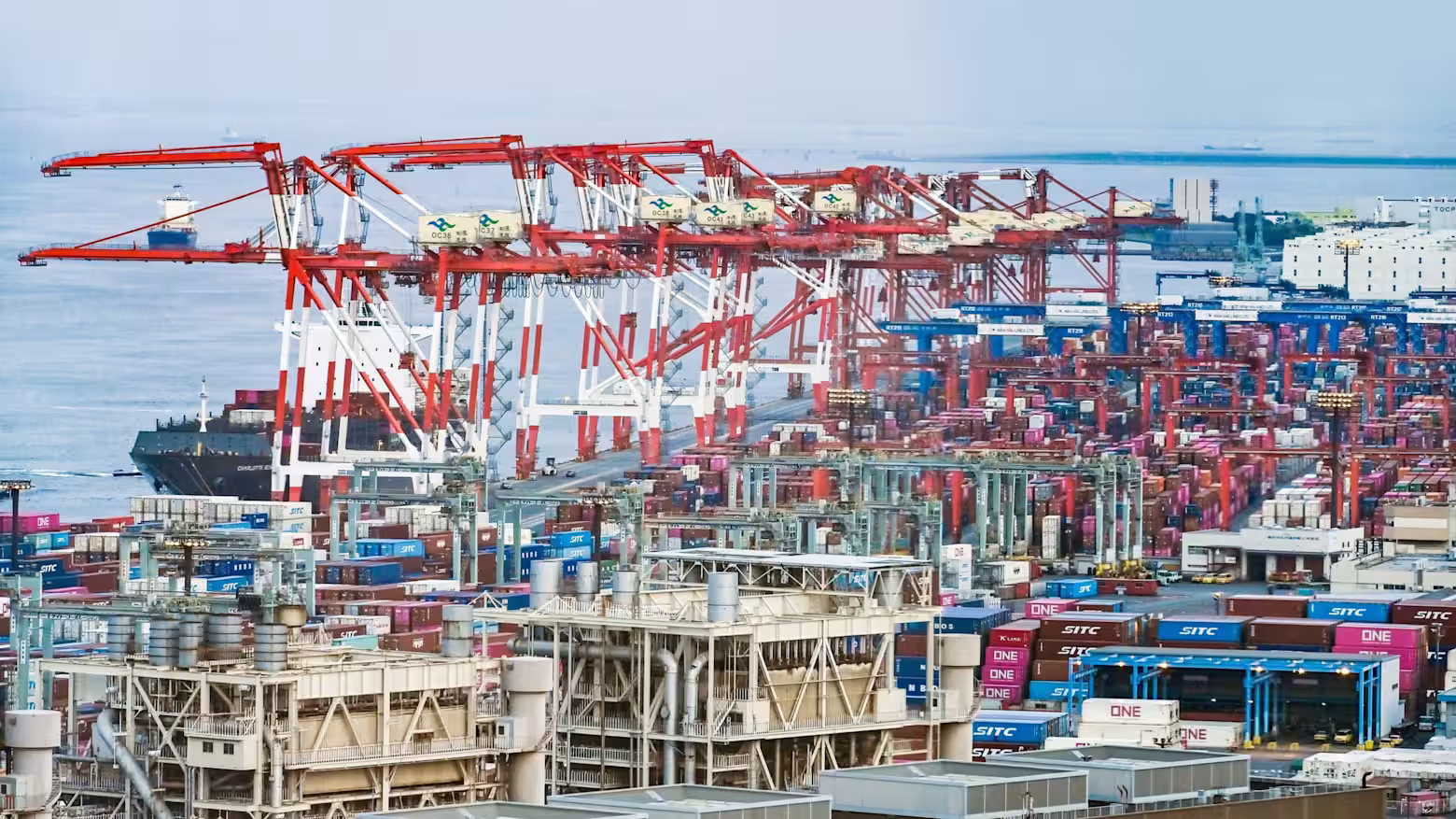
Japan’s Export Surge: Strong Overseas Demand Meets Rising Domestic Risks
Japan’s exports have jumped sharply on the back of strong Asian demand, lifting sentiment and supporting growth. Yet beneath the optimism are structural vulnerabilities, from fragile domestic consumption to fiscal pressures and industrial concentration, that complicate the outlook. This article examines how Japan’s export boom fits into the broader macroeconomic picture and what risks policymakers must navigate next.
The recent surge in exports has provided a welcome boost to the Japanese economy, delivering its strongest early-year trade momentum in more than a decade. Shipments to major Asian partners have climbed sharply, reflecting both cyclical demand and Japan’s entrenched role in regional supply chains. For policymakers, the rebound offers evidence that external momentum remains intact even as domestic challenges build. For investors, it raises a familiar question: can Japan rely on exports to carry its recovery, or does the growth narrative rest on fragile foundations?
The export expansion is driven primarily by strength in key industrial sectors, automobiles, electronics components, machinery, and chemical products. These categories have benefited from both revived regional manufacturing activity and ongoing demand for intermediate goods feeding into Asia’s technology production. This reinforces Japan’s long-standing competitive advantage in high-value manufacturing. When Asian economies accelerate, Japan often gains through increased orders for precision instruments, semiconductors, and transport equipment.
Yet the optimism surrounding the export numbers obscures several underlying tensions. Domestic demand remains subdued, with households still adjusting to years of elevated inflation and weaker real wage gains. Consumption has not kept pace with export-driven industrial performance. This imbalance exposes Japan to external shocks: if the regional demand cycle weakens, the domestic economy lacks sufficient internal momentum to offset the decline.
Another risk emerges from fiscal constraints. Japan’s debt levels remain among the highest relative to GDP in the developed world. While low interest rates have historically helped stabilize debt servicing, rising issuance needs and increased sensitivity to global yield movements create vulnerabilities. A strong export sector can support tax revenues, but it cannot fully insulate public finances from long-term structural pressures, particularly as population aging increases social spending demands.
The labor market adds a further layer of complexity. While headline employment figures have held firm, demographic trends continue to shrink the working-age population. Export-driven industries face persistent labor shortages, which could constrain production capacity over time. Without meaningful productivity gains or expanded labor force participation, particularly among women and older workers, Japan may struggle to sustain elevated export volumes.
The exchange rate also plays a crucial role. A weaker yen has historically supported export competitiveness, boosting corporate profits and improving terms of trade. However, prolonged currency weakness brings trade-offs. It raises import prices, contributes to domestic inflation, and pressures households. Moreover, if the yen begins to appreciate on shifting global interest rate expectations or changing capital flows, export margins could narrow. Japanese firms have adapted through overseas production and diversified supply chains, but the currency channel still matters significantly.
Geopolitical dynamics introduce additional uncertainty. Japan’s trade landscape depends heavily on regional stability and predictable supply chain relationships. Any disruption, from tensions in East Asia to shifts in US-China policy, can quickly alter trade flows. Japan’s strategic diversification efforts aim to mitigate these risks, but the region’s structural interdependencies ensure that exposure remains high.
Despite these challenges, the export surge has meaningful macroeconomic implications. It supports industrial output, improves capacity utilization, and strengthens business sentiment. Corporate investment may accelerate in response, especially in sectors tied to global technology trends. Export performance also bolsters Japan’s external balance, providing a buffer against financial volatility.
For policymakers, the key question is whether this export-led upswing can transition into a more balanced growth profile. Sustainable expansion requires stronger domestic demand, improved wage dynamics, and stable inflation expectations. The export boom provides breathing room, but it cannot shoulder the entire burden of recovery indefinitely. Structural reforms, from labor market flexibility to productivity-enhancing investment, remain critical.
For investors, Japan’s story remains nuanced. Strong external performance supports corporate earnings and enhances equity valuations, particularly in cyclical and industrial sectors. Yet the tail risks, fiscal fragility, demographic decline, and external dependence, warrant close monitoring. Export strength can fuel momentum, but the trajectory depends on global conditions as much as domestic resilience.
The export surge underscores Japan’s enduring strengths but also its vulnerabilities. As global demand cycles shift and regional competition intensifies, maintaining export leadership will require adaptability, innovation, and stable macroeconomic policy. The current momentum is real, but so are the risks that shadow it.
Cite this article
“Japan’s Export Surge: Strong Overseas Demand Meets Rising Domestic Risks.” The Economic Institute, 19 February.
How did this article make you feel?
Comments
No comments yet. Be the first to share your thoughts.
Further Reading
More from Global Economics
The Iran Escalation and America's Economic Tightrope
Trump's strikes on Iran have introduced a dangerous new variable into an already fragile US economic equation, and Washington has precious little room to absorb the shock.
Global EconomicsThe Strait Gambit: Why Iran's Oil Dependency on China Is Its Greatest Strategic Weakness
As Iran chokes off the Strait of Hormuz to pressure the West, it is simultaneously strangling the very trade lifeline that keeps its own economy alive.
Global EconomicsOil at the Brink: How the Iran War Is Reshaping Global Energy Markets
With crude prices nearing $100 a barrel and the Strait of Hormuz effectively closed to normal traffic, the economic fallout from the US-Israel campaign against Iran is forcing a rapid realignment of global energy supply chains.
Global EconomicsThe Strait of Hormuz Gamble: Why Trump's Naval Pledges Can't Calm Rattled Energy Markets
Washington's promise of naval escorts and insurance guarantees for Gulf shipping offers symbolic reassurance, but the economics of energy disruption are already doing their damage.