How Europe Is Rethinking Its Export Led Growth Model For A Riskier World
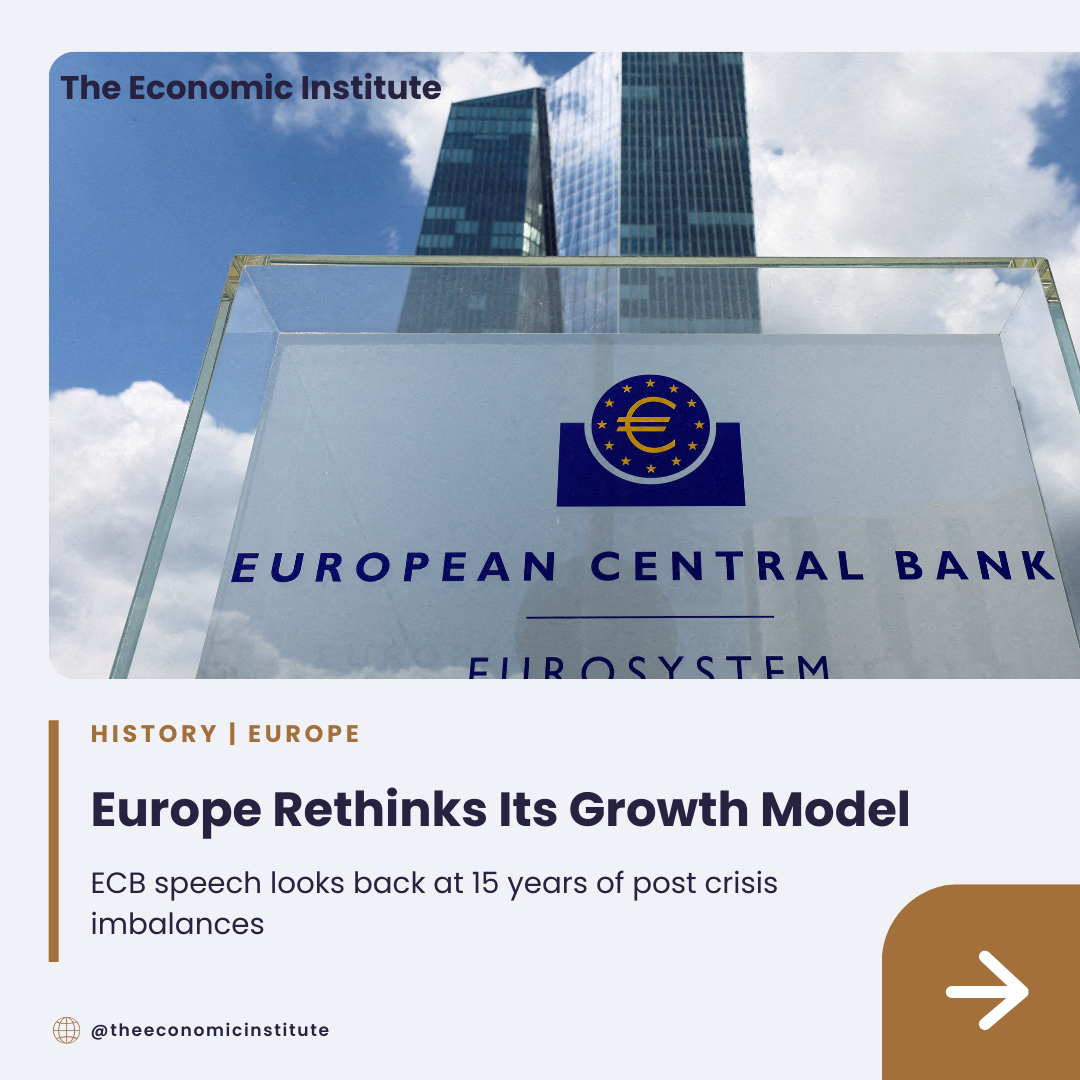
For more than a decade, Europe leaned heavily on external demand and current account surpluses. Now rising geopolitical risk, slower global trade and domestic underinvestment are forcing a rethink of that strategy, with the European Central Bank calling for stronger home grown demand.
For much of the period since the global financial crisis, the euro area followed a relatively simple roadmap. Keep domestic demand contained, regain cost competitiveness, export aggressively to the rest of the world and accumulate large current account surpluses. That model helped repair external balances and calm market fears about the euro, but it came with significant side effects. Domestic investment lagged, consumption remained subdued and potential growth underperformed the block's size and income level.
Fifteen years later, the global environment looks very different. Trade is still important, but it is no longer the ever expanding engine that it used to be. Tensions between major powers have increased, supply chains are being reconfigured and export markets are less predictable. In that context, the European Central Bank and other policy voices in the region are asking a difficult question. Can Europe continue to rely primarily on external demand, or does it need a new growth model that makes far better use of its internal market?
To understand the shift, it helps to recall what happened in the decade after 2008. The financial crisis exposed weaknesses in bank balance sheets and public finances. Several euro area countries lost access to market funding or paid very high risk premia. A strategy built on regaining competitiveness and running surpluses was politically attractive. It promised fiscal repair, improved external positions and restored confidence in the currency.
The approach worked on its own terms. Current account deficits in stressed countries turned into surpluses. The euro area as a whole became a net lender to the rest of the world. But inside the bloc, domestic demand grew only very slowly. Investment stayed well below pre crisis trends, especially in public infrastructure and innovation. Unemployment fell eventually, but only after long periods of slack that likely left scars on skills and productivity.
Fast forward to the mid 2020s and several new pressures converge. First, the global trade system faces strategic fragmentation. Major economies are using industrial policy, export controls and reshoring incentives to bring production closer to home or to trusted partners. That makes it harder for any region to rely on a simple export driven strategy. Second, the green transition requires very large domestic investment in energy, transport and building stock. Third, geopolitics has underlined the risks of overdependence on any single supplier or route for critical goods.
Against this backdrop, the ECB has begun to highlight the need for stronger domestic demand as a pillar of resilience. The argument is not that exports will become unimportant. Rather, Europe will need a more balanced mix of growth drivers. That means higher investment in physical and digital infrastructure, more support for innovation, and policies that encourage households and firms to spend and invest in the internal market.
There are at least three economic reasons for such a shift. The first is diversification of risk. An economy that depends too heavily on demand from the rest of the world becomes vulnerable to shocks that originate elsewhere, such as trade conflicts or slowdowns in key partner countries. Stronger domestic demand can cushion external shocks, stabilizing employment and incomes.
The second reason is productivity. Under investment in infrastructure, research and development, and skills constrains productivity growth. As populations age, European countries will not be able to rely on labor force expansion to drive growth. They will need higher output per worker instead. That in turn requires sustained investment in both capital and human capabilities.
The third reason is social cohesion. Long periods of subdued domestic demand tend to limit real wage growth and constrain public spending on services. While current account surpluses may look impressive in macroeconomic tables, they can coexist with frustration among households who feel that growth is passing them by. A strategy that explicitly aims to improve domestic living standards can help strengthen support for open markets and the European project.
Turning this analysis into policy is not trivial. Europe is not a single fiscal entity. It is a currency area with many sovereign governments, each with its own political constraints and debt dynamics. While the ECB can influence financing conditions, it cannot decide how much individual states invest or which projects they prioritize. That depends on national choices and on collective agreements at the European level.
Several levers are available. Reform of fiscal rules can help create more room for productive investment, especially in green and digital projects that have high long term returns. Deepening capital markets can mobilize private savings for European projects rather than sending them abroad. Completing the banking union and capital markets union can reduce financial fragmentation and lower the cost of capital across the bloc.
Industrial policy will also play a role. Strategic investment in clean energy, digital infrastructure and key technologies such as semiconductors or advanced materials can support both resilience and growth. The challenge is to design such policies in ways that complement rather than undermine competition, and that respect international rules while defending legitimate European interests.
For the ECB itself, the rethink of the growth model shapes the environment in which monetary policy operates. A more dynamic internal market with higher investment and innovation may raise the economy's potential growth rate and change the equilibrium interest rate. That would influence how the central bank judges the stance of policy and the speed with which it adjusts rates.
Households and businesses will experience the shift through many channels. More domestic investment can create job opportunities in construction, engineering, services and creative industries. Better infrastructure and digital connectivity can improve daily life and productivity. A more resilient energy system can reduce vulnerability to price spikes and outages.
The transition will not be smooth or uniform. Some export oriented sectors may face headwinds as global demand patterns change. Regions that benefited most from the old model may feel exposed. Managing this shift will require careful policy design, social dialogue and targeted support for regions and workers most affected.
What is clear is that Europe is entering a new phase. The export led strategy that dominated the post crisis era is not disappearing, but it is being supplemented and rebalanced. In a world where trade is more contested and shocks are more frequent, building a stronger internal engine of growth is not just an economic preference. It is a strategic necessity.
Cite this article
“How Europe Is Rethinking Its Export Led Growth Model For A Riskier World.” The Economic Institute, 26 February.
How did this article make you feel?
Comments
No comments yet. Be the first to share your thoughts.
Further Reading
More from Economic History
Macro History In The Spotlight: How Long Run Data Shapes Today’s Policy Debates
A new wave of research and seminars is bringing macro history to the center of policy discussions. This article explains why long run data on inflation, wars, debt and trade is becoming essential for understanding today’s choices.
Economic HistoryWhat Past Financial Crises Can Teach Us About The Risks Of 2026
Economic historians are revisiting classic banking and currency crises to understand today’s debt heavy, shock prone global economy. This article connects historical crisis patterns to current vulnerabilities and explains why ignoring those echoes would be a mistake.
Economic HistoryWhy Old Financial Crises Still Shape Today’s Policy Choices
From gold standard panics to the global financial crisis, past episodes of market turmoil still guide how central banks and regulators think about risk. This article connects historical crisis patterns to current vulnerabilities and explains why the echoes matter in 2026.