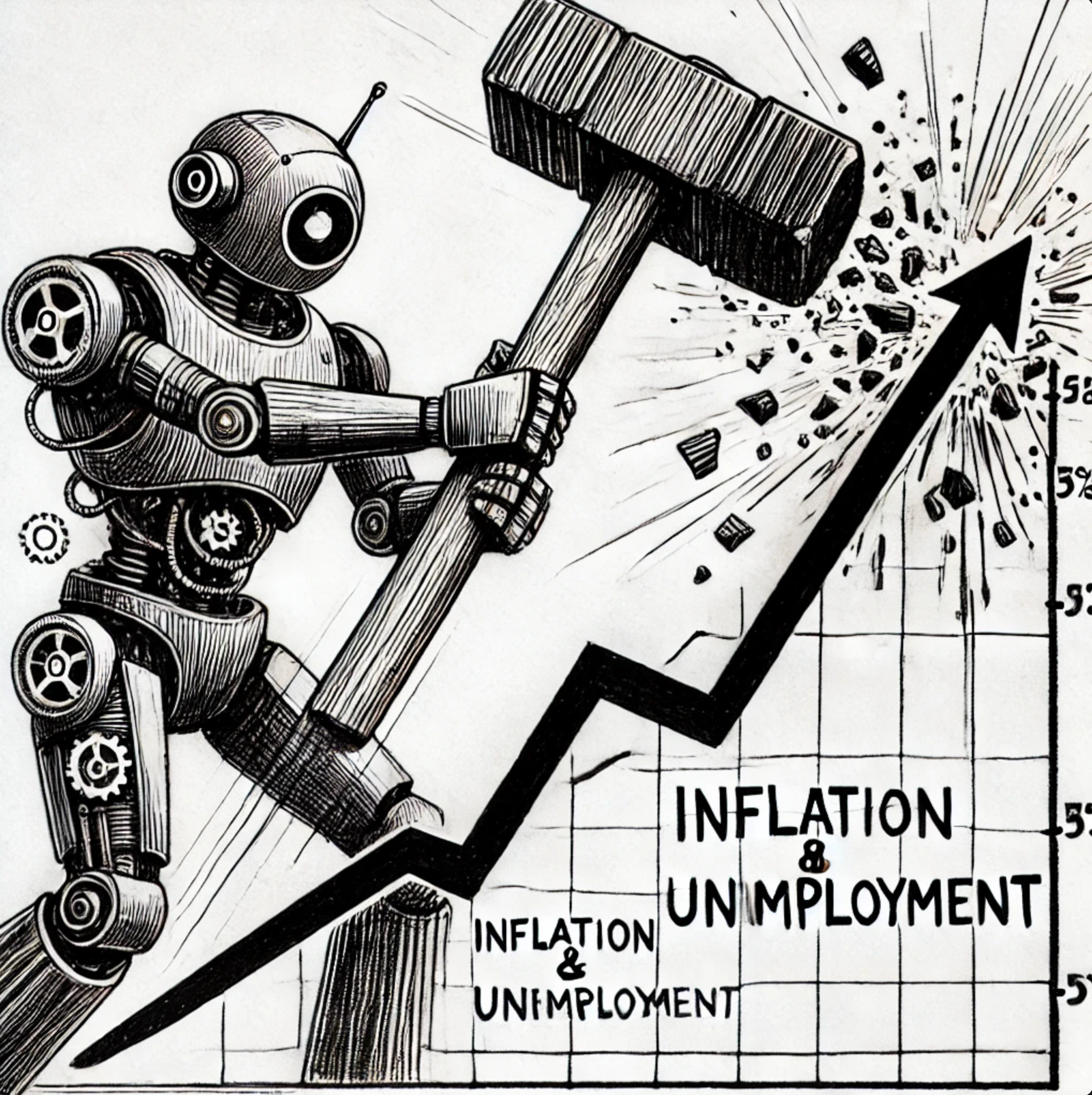
Will Artificial Intelligence Reduce Inflation or Reshape It?
Artificial intelligence is often described as inherently disinflationary, a productivity revolution that will lower costs and stabilize prices. The reality is more complex. AI could reduce structural inflation in some sectors while intensifying demand, capital spending, and wage polarization in others. This analysis examines how AI interacts with productivity, labor markets, corporate pricing power, and long-term interest rates.
Every major technological revolution has carried a macroeconomic promise. Railroads would integrate markets and lower transport costs. Electrification would unlock industrial efficiency. The internet would compress information costs and democratize commerce. Artificial intelligence is now cast in a similar role. Many analysts argue that AI will lower inflation by boosting productivity and reducing unit labor costs. Others warn that it may instead create new demand surges, investment booms, and pricing power that reshape inflation rather than suppress it. The truth likely lies in the interaction between productivity gains and distributional shifts across sectors.
At first glance, the disinflation case is compelling. Inflation, in its simplest macroeconomic framing, reflects the relationship between demand and productive capacity. If AI increases productive capacity by allowing firms to produce more output with the same or fewer inputs, then unit costs fall. Lower unit costs can translate into lower prices, particularly in competitive industries. Automated customer service systems, predictive maintenance in manufacturing, AI-driven logistics optimization, and software development acceleration all reduce time and labor intensity. If these efficiency gains scale broadly across the economy, the supply side expands, easing inflationary pressure without requiring restrictive monetary policy.
Yet productivity does not automatically translate into lower prices. Firms may retain some gains as higher margins, especially in concentrated markets. The AI ecosystem itself is capital intensive and dominated by firms with substantial market power in cloud infrastructure, advanced chips, and foundational models. When productivity improvements occur within highly concentrated sectors, cost savings can reinforce profitability rather than reduce consumer prices. In that case, the inflation effect becomes ambiguous. Measured productivity rises, but price dynamics depend on competitive structure.
The demand side adds another layer of complexity. Technological revolutions historically trigger investment cycles. The current AI wave is already driving capital expenditure in data centers, semiconductor fabrication, energy infrastructure, and network capacity. These investments stimulate aggregate demand in the short to medium term. Construction, engineering, chip manufacturing, and energy sectors experience increased activity. When demand accelerates faster than supply can adjust, inflationary pressures may intensify before productivity gains are fully realized. In this sense, AI can initially be pro-inflationary even if its long-run effect is disinflationary.
Labor markets further complicate the picture. AI does not eliminate work uniformly. It substitutes for certain cognitive tasks while complementing others. Routine analytical and administrative roles may face downward wage pressure as automation expands. At the same time, demand for highly skilled engineers, data scientists, and infrastructure specialists rises. Wage polarization can emerge. From a macro perspective, the net wage effect depends on how quickly displaced workers transition into new roles and how concentrated high-income gains become. If AI amplifies income inequality, aggregate demand patterns may shift toward asset markets and high-end services, influencing inflation in specific sectors rather than uniformly across the consumption basket.
There is also the question of services inflation, which has proven more persistent in recent cycles. Services are typically labor intensive. If AI significantly enhances productivity in healthcare administration, legal research, education technology, and financial services, the structural cost base of these industries could decline. That would be a genuine disinflationary force. However, if AI primarily augments professionals rather than replacing them, service prices may not fall. Instead, service quality may improve, justifying stable or even higher pricing. In that case, measured inflation remains sticky even as underlying efficiency improves.
Monetary policy implications are substantial. Central banks estimate the neutral interest rate partly based on productivity growth. Higher productivity can raise the neutral rate by increasing expected returns on investment and lifting equilibrium growth. If AI accelerates productivity meaningfully, central banks may need to recalibrate their assumptions about long-term potential output and real rates. Paradoxically, a more productive economy may sustain higher interest rates without triggering recession. That is not because inflation is higher, but because growth potential is stronger.
Financial markets are already embedding expectations of an AI-driven productivity boost into equity valuations and capital allocation decisions. If those expectations materialize, inflation dynamics could become less constrained by traditional labor bottlenecks. If they disappoint, markets may confront a gap between anticipated supply expansion and actual output. That gap could produce volatility in both inflation expectations and rate pricing.
Another often overlooked dimension is energy. AI infrastructure is energy intensive. Data centers require significant electricity, and advanced semiconductor manufacturing consumes substantial power and water resources. If energy supply does not expand alongside AI adoption, localized cost pressures may appear. In energy-constrained environments, technology-driven demand can translate into higher utility costs. Over time, however, AI may also optimize grid management, renewable integration, and energy efficiency, mitigating those pressures. The net effect depends on the speed of complementary infrastructure development.
From a measurement standpoint, AI also challenges inflation statistics. Quality adjustments become more complex when products improve rapidly. If AI-enabled software delivers dramatically better functionality at similar prices, traditional inflation metrics may overstate price growth by failing to fully capture quality gains. This issue is not new; it has existed in computing for decades. However, as AI spreads across services and consumer platforms, the measurement problem becomes broader. Real output may grow faster than measured output, and real inflation may be lower than recorded inflation. Policymakers must account for these distortions when interpreting data.
The most realistic assessment is that AI will not simply reduce inflation or increase it. It will redistribute inflationary pressures across sectors and time horizons. In the short term, investment booms and energy demand may elevate certain prices. In the medium term, productivity gains may ease goods and service costs. In the long term, structural changes in labor markets and market concentration will determine how broadly those gains are shared.
For businesses, the implication is strategic rather than purely macroeconomic. Firms that leverage AI to genuinely reduce costs in competitive markets may gain pricing flexibility and margin resilience. Firms operating in concentrated ecosystems may reinforce pricing power. For investors, distinguishing between temporary demand-driven inflation and durable supply expansion becomes critical. For policymakers, humility is essential. Technological revolutions rarely follow linear paths. Their macroeconomic impact depends on diffusion speed, regulatory responses, infrastructure readiness, and competitive dynamics.
Artificial intelligence may well become a powerful disinflationary force over time. But it is equally plausible that it reshapes inflation rather than suppresses it, changing where price pressures emerge and how monetary policy responds. The macro story of AI will not be written in a single inflation print or a single earnings cycle. It will unfold through years of capital formation, labor adjustment, and institutional adaptation. The question is not whether AI affects inflation. It is how, when, and through which channels the effect dominates.
Cite this article
“Will Artificial Intelligence Reduce Inflation or Reshape It?.” The Economic Institute, 18 February 2026.