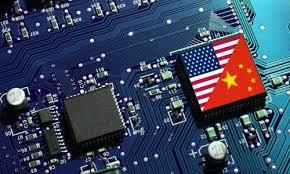
AI Export Controls and the New Tech Cold War
Artificial intelligence has become a strategic asset, and export controls on advanced chips are now instruments of economic statecraft. As the United States tightens restrictions on semiconductor exports to China, global supply chains, capital expenditure cycles, and innovation trajectories are being reshaped. This analysis explores how AI export controls function as a macroeconomic variable rather than a narrow trade tool.
Technology policy has moved from the periphery of trade negotiations to the center of geopolitical strategy. Advanced semiconductors, particularly those used in artificial intelligence training and high performance computing, are now viewed as dual use assets with both commercial and military implications. Export controls are no longer isolated regulatory adjustments. They are deliberate instruments designed to shape the pace and geography of technological progress.
The restrictions imposed by the United States on the export of advanced AI chips and semiconductor manufacturing equipment to China reflect a broader recalibration of economic policy. The objective is not simply to regulate trade flows. It is to slow the technological advancement of strategic competitors in domains deemed critical for national security. In doing so, export controls alter corporate investment decisions, supply chain structures, and research strategies across continents.
For semiconductor manufacturers, compliance with export restrictions introduces revenue uncertainty. China has historically represented a significant market for advanced chips. Limiting access reduces addressable demand for certain product categories. Firms must then reallocate supply toward other regions or adjust product specifications to comply with regulatory thresholds. This recalibration can reshape revenue composition and alter research and development priorities.
Capital expenditure cycles are similarly affected. AI infrastructure investment depends on the availability of high performance chips. When access to leading edge components is constrained, affected economies may accelerate domestic development programs. This can lead to parallel innovation tracks rather than integrated global ecosystems. Governments may expand subsidies to cultivate local semiconductor capacity, reinforcing industrial policy dynamics already underway.
The broader macroeconomic implications extend beyond the technology sector. AI is increasingly integrated into productivity strategies across manufacturing, finance, healthcare, and logistics. Restrictions on chip availability influence how quickly AI diffusion occurs within affected economies. Slower diffusion can moderate productivity growth, which in turn shapes long term GDP trajectories. Conversely, economies with preferential access to advanced chips may experience faster technological adoption and associated growth gains.
Financial markets treat export controls as signals of sustained strategic rivalry. Technology equities often react sharply to regulatory announcements, reflecting both lost revenue expectations and heightened geopolitical risk premiums. Investors must incorporate policy trajectory into valuation models. The risk is not merely cyclical. It is structural. When export controls become embedded within foreign policy, their reversal becomes politically complex.
Supply chains also evolve in response. Firms diversify production footprints to reduce exposure to regulatory concentration. Semiconductor fabrication, packaging, and design activities may become more geographically distributed. While diversification enhances resilience, it can raise costs. Fragmentation of previously integrated supply chains reduces economies of scale and introduces coordination inefficiencies. The balance between security and efficiency becomes a central economic trade off.
There is a paradox embedded within export control strategy. Restricting technology transfer may slow competitors, but it can also incentivize accelerated domestic innovation efforts. Historical precedents suggest that technology denial can catalyze long term self sufficiency initiatives. The ultimate impact depends on the targeted country’s institutional capacity, access to capital, and talent base. In the case of China, significant resources are being directed toward domestic semiconductor development, making the outcome uncertain.
Central banks and macroeconomic analysts increasingly monitor technology policy alongside traditional economic indicators. Export controls influence capital flows, foreign direct investment, and industrial production. They shape the distribution of global innovation. In this sense, semiconductor policy has become a macro variable, affecting growth differentials and competitive positioning.
For multinational corporations, strategic planning must now integrate regulatory scenario analysis. Firms operating across jurisdictions must anticipate evolving compliance requirements and potential retaliatory measures. Risk management extends beyond currency hedging and commodity exposure to encompass technology access risk. Supply contracts, research partnerships, and long term capacity decisions all require policy awareness.
The emergence of a technology focused strategic rivalry does not imply a complete decoupling of global economies. Interdependence remains deep, particularly in lower tier semiconductor components and consumer electronics. However, the highest value segments of the AI ecosystem are increasingly shaped by policy boundaries. The competitive landscape is being redrawn along geopolitical lines.
Innovation itself may change character under these constraints. Collaboration across borders becomes more complex when export licensing governs knowledge transfer. Research ecosystems fragment, and duplication of effort increases. While competition can spur progress, fragmentation can slow cumulative advancement. The balance between security objectives and global innovation efficiency is delicate.
The term Tech Cold War captures the strategic tension embedded in current policy choices. Unlike past ideological rivalries, this contest centers on computational capacity and algorithmic sophistication. AI chips are not merely commercial products. They are foundational inputs into economic modernization and defense capability. As such, export controls carry weight far beyond trade statistics.
In the years ahead, the effectiveness of export controls will be measured not only by immediate commercial impact but by long term innovation trajectories. Whether the policy slows technological convergence or accelerates parallel development remains to be seen. What is clear is that AI export controls have transformed semiconductor trade into a core instrument of economic strategy. Investors, policymakers, and corporate leaders must treat technology regulation as a structural force shaping the global economy.
Cite this article
“AI Export Controls and the New Tech Cold War.” The Economic Institute, 18 February 2026.